
How to Successfully Transition a Web2 Business to Web3
Author:

Alec Wilson
Published on
November 7, 2025
.png)
Over the past seven years at Spexi, it was apparent that transitioning from Web2 to Web3 isn't about slapping a token on an existing business and calling it decentralized. It's a thoughtful and strategic journey that requires balancing the demands of running a real business with the opportunities that blockchain technology offers. It also requires navigating the oft-misleading hype new technologies like this can attract.
Spexi is now the founding core contributor of the LayerDrone network: the world's largest standardized drone imagery network, with over 167,000 successful missions (representing roughly 22,000 flight hours, or 2.5 flight years), 6,700+ registered pilots, and over five-million acres of ultra-high resolution imagery mapped on the network (that’s roughly 20-million images!).
We developed a playbook for this transition. Here's what we've learned.
This might sound obvious, but it's the most commonly overlooked principle in Web3. Real businesses solve real problems for real customers before introducing tokens.
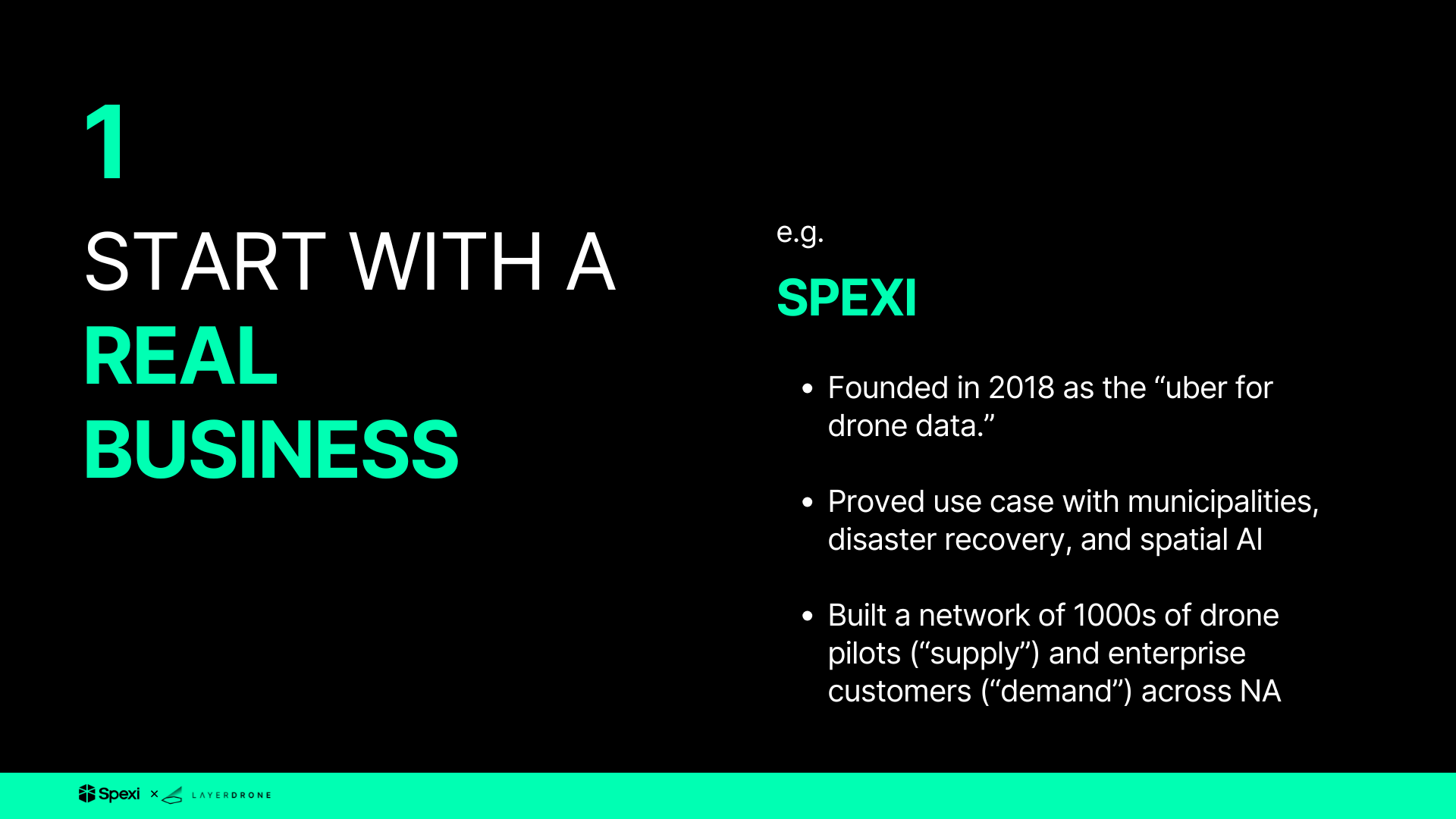
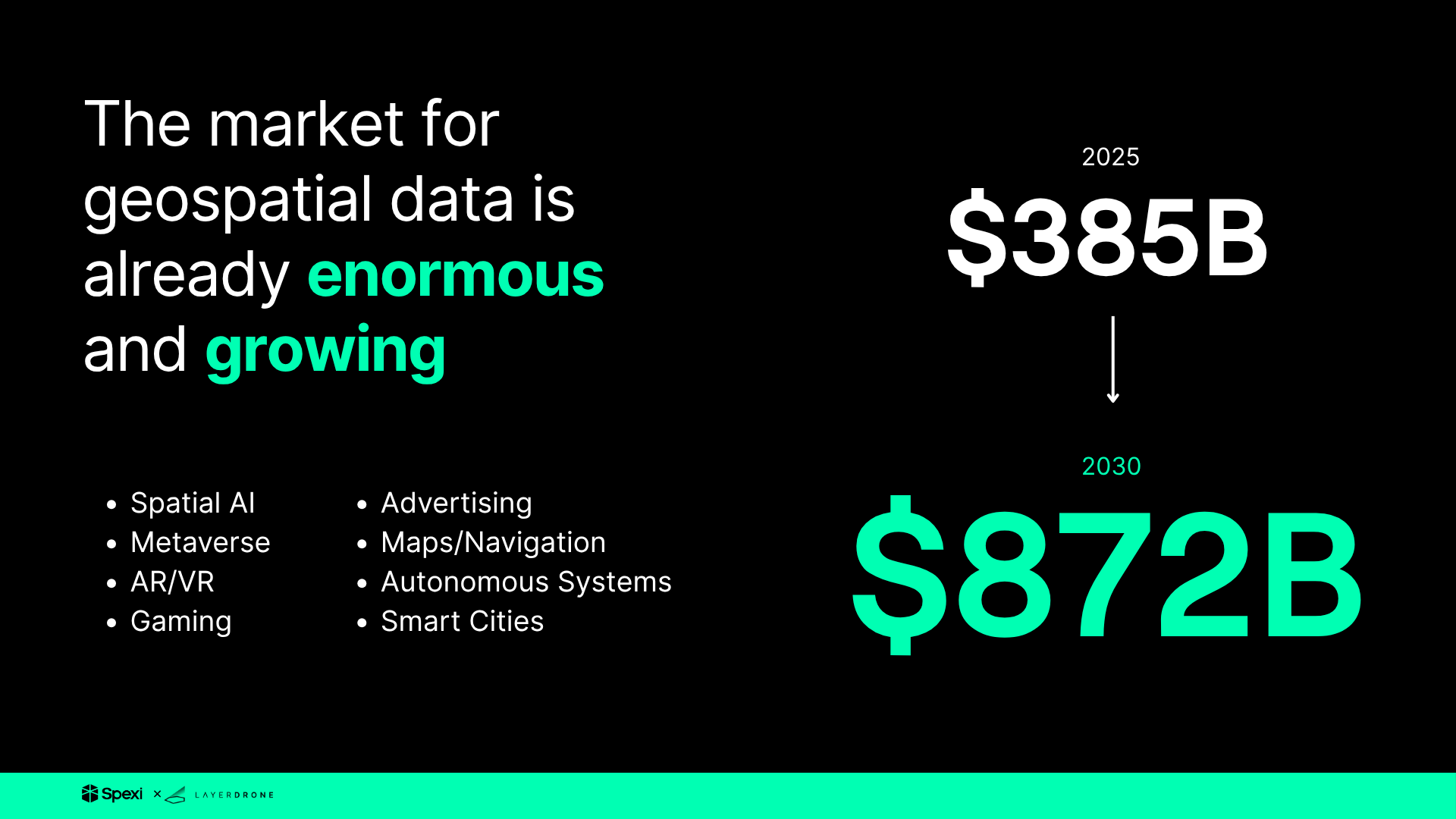
When Spexi was founded in 2018, the team wasn’t thinking about tokens. Spexi was looking at a massive market opportunity, and it’s only grown since then: the geospatial data market is worth $385 billion as of 2025, and it’s projected to reach $872 billion by 2030. Traditional aerial data from planes and satellites was low-resolution, infrequently updated, and prohibitively expensive. Drones can provide better detail and faster updates at a fraction of the cost—but the drone data ecosystem was fragmented and impossible to scale.
So Spexi became the "Uber for drone data", a platform that standardized drone imagery collection and connected drone pilots with customers who needed high-quality aerial data. The business focused on proving three things:
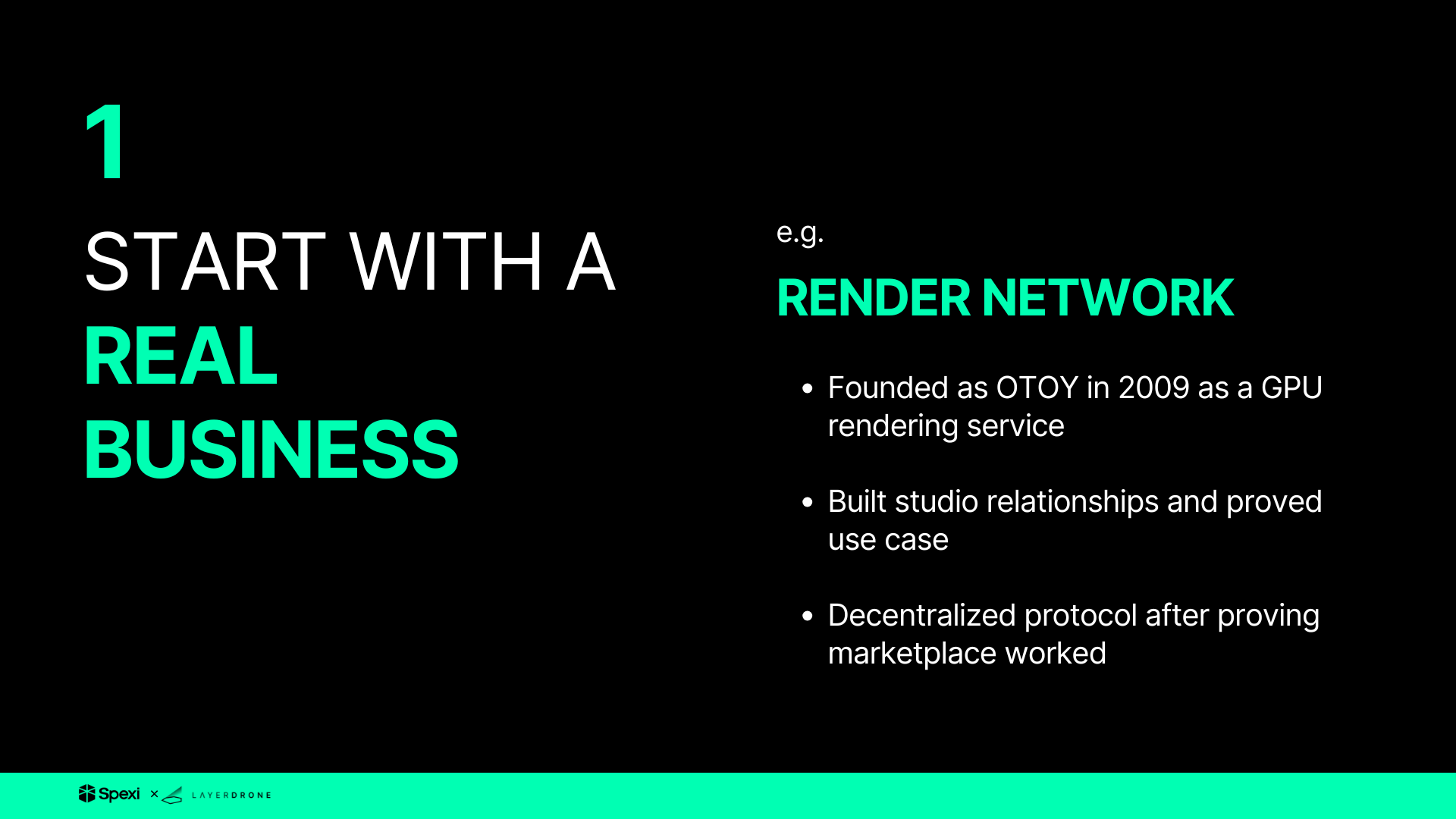
For example: Render Network launched as OTOY in 2009, spent years building studio relationships and proving their GPU rendering service actually worked, and only then introduced their decentralized protocol. That's the right sequence.
If your business doesn't work without a token, it won't work with one.
Once you have a working business, you need to bring your community along for the Web3 journey. The key principle here is to incentivize supply, not bribe it into existence. Rewards should correlate to the value created.
With the Spexi app, drone pilots were receiving value before any blockchain functionality was introduced:
In addition to the originalcash rewards system, Spexi uses a “Reputation Points” (RP) system to track pilot contributions to the network (i.e. successful missions). The LayerDrone foundation continues to use RP to track contributions, with another points system, “Experience Points” (XP), introduced in 2025 to track non-pilot (i.e. community) contributions to the network. Crucially, both systems amplify existing behaviours instead of creating artificial activity. They also align product, network, and contributor incentives.
This approach ensures three critical things:
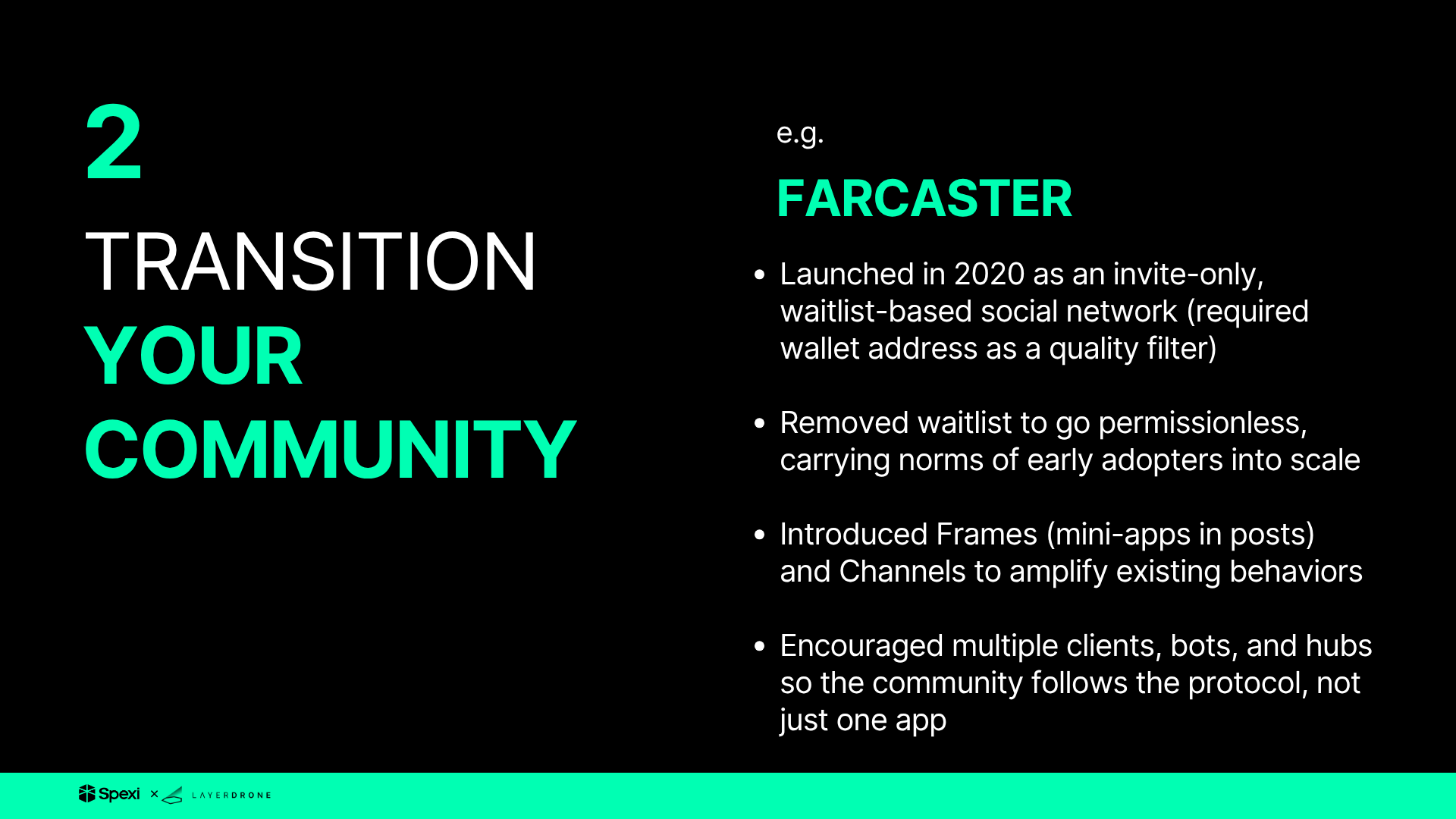
For example: Farcaster launched in 2020 as an invite-only social network, using the exclusivity and wallet requirement as a quality filter. When they removed the waitlist and went permissionless, they'd already established strong community norms. Their introduction of Frames and Channels didn’t create new behaviors—it amplified what users were already doing naturally.
Your community needs a reason to exist outside of a token, and they cannot be left behind in the pursuit of one.
A lot of businesses that attempt to cross the web2 to web3 chasm fail because they decentralize too fast. Minimal decentralization in the early stages is a feature, not a bug. Maximum decentralization offers maximum risk with minimal control — which is exactly what you don't want when you're still figuring things out.
The key is knowing what to decentralize and when, with the balance of control and complexity as your primary levers.
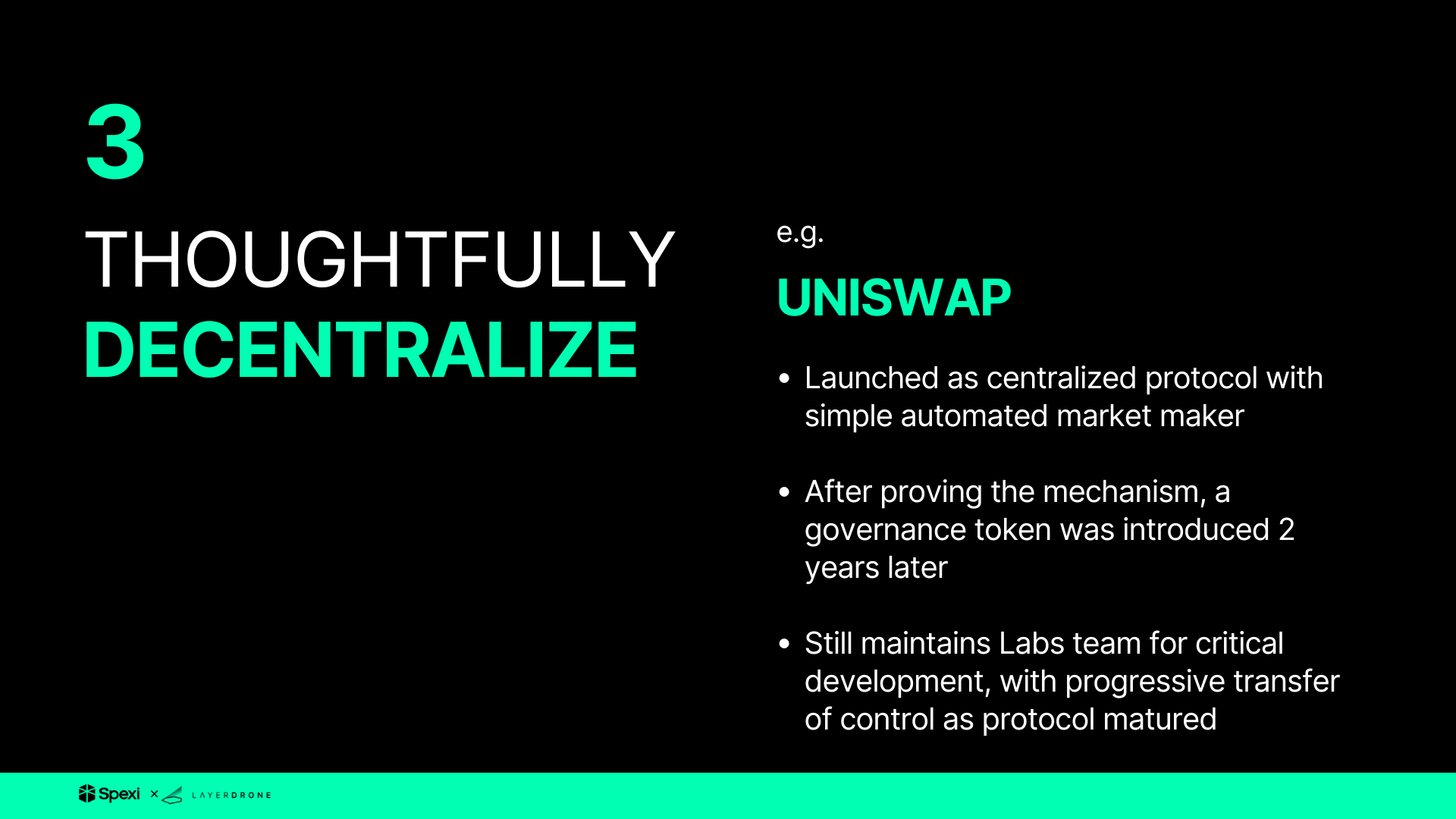
For example: Uniswap launched as a fully centralized protocol with a simple automated market maker. After proving the mechanism worked, they introduced a governance token two years later. Even now, they maintain a Labs team for critical development, with progressive transfer of control as the protocol matured.
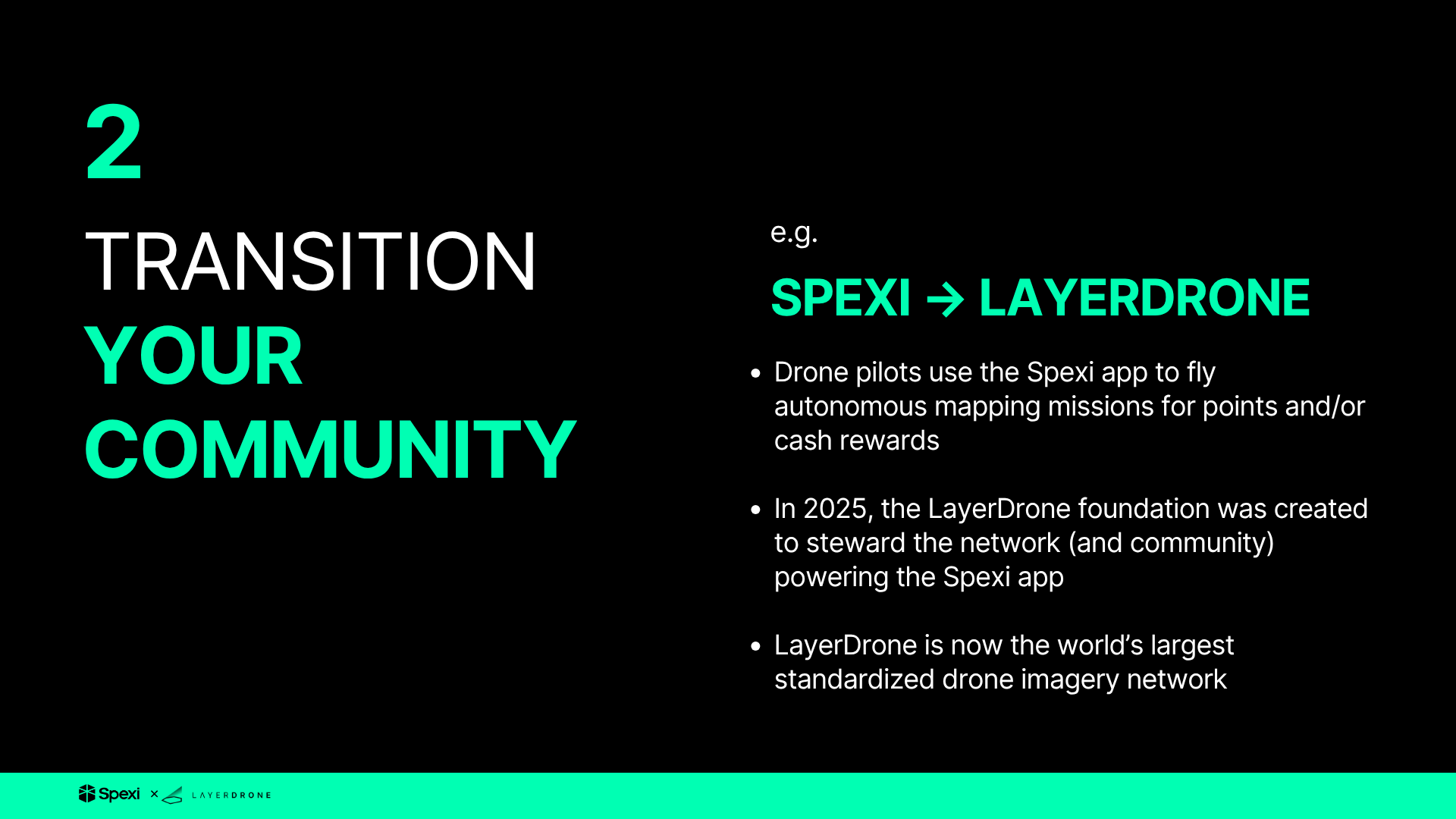
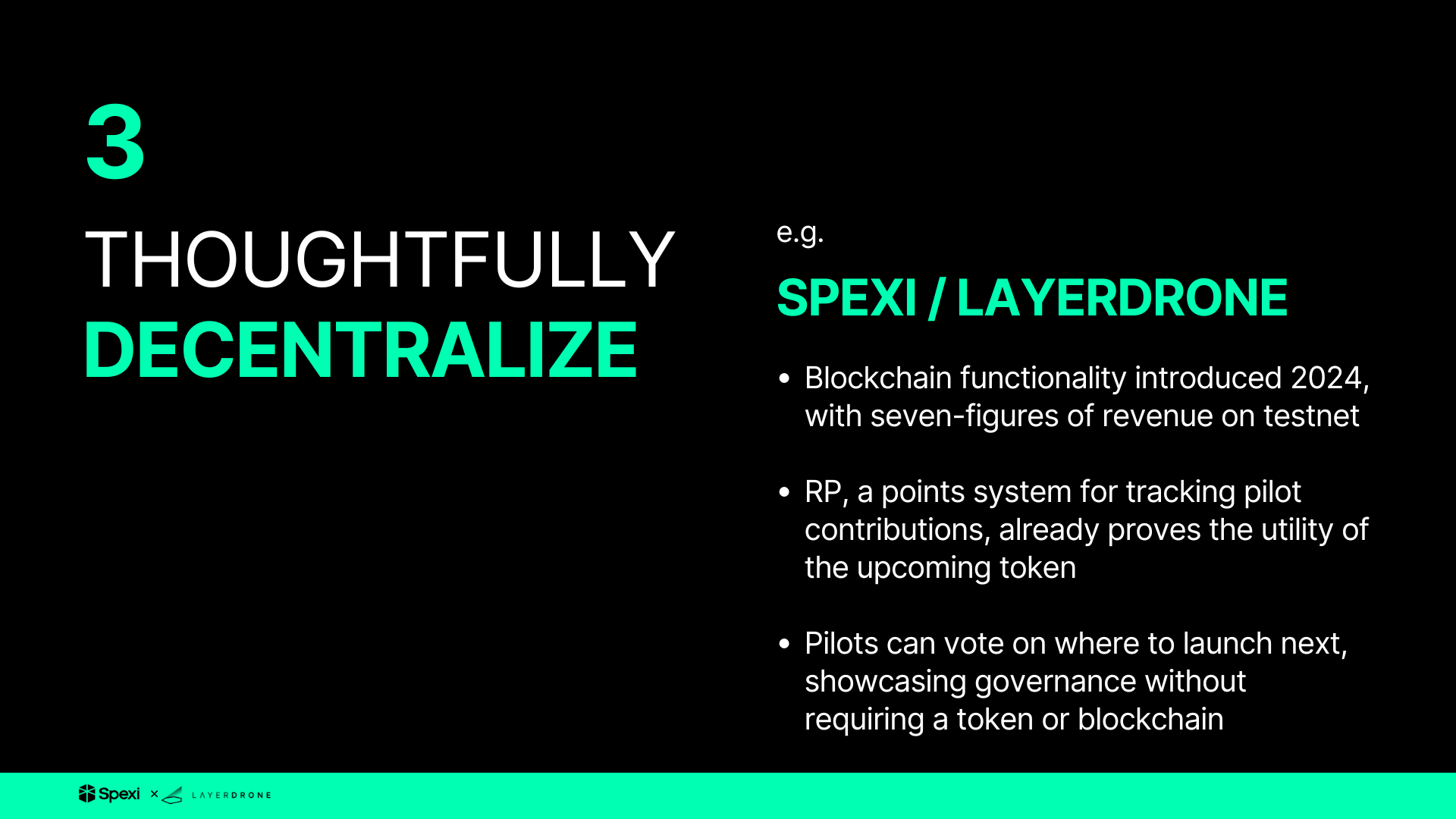
Spexi introduced blockchain functionality in 2024, with a year of testnet producing over seven-figures in revenue. In 2025, the LayerDrone Foundation was created to steward the network for mainnet release. Initially, the LayerDrone Network will be minimally decentralized to give maximum operating flexibility as the network scales. This isn’t a compromise—it’s strategic.
If it requires accountability or control, it shouldn’t be decentralized until the associated risks can be mitigated.
Running a real business and launching a token are two different games with different rules. You need to win at both without letting either cannibalize the other.
The business game focuses on:
The token game focuses on:
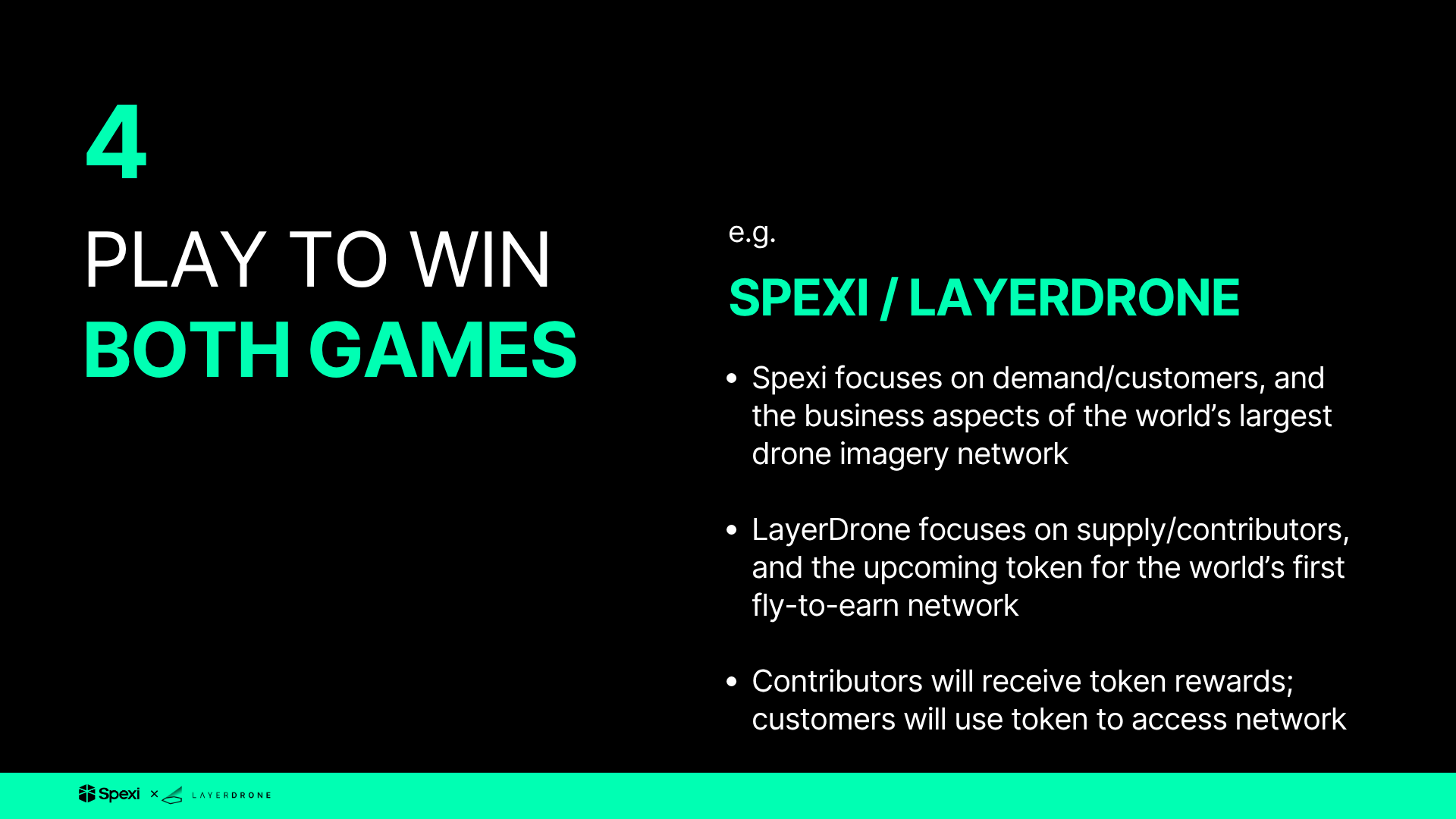
Spexi and LayerDrone have separated these concerns organizationally:
Contributors receive token rewards; customers use tokens to access the network. The two sides complement each other without compromising either.
This separation is crucial. Too many projects destroy their business fundamentals by over-optimizing for token performance, or tank their token by ignoring the needs of traders and holders. You need to respect both games.
Why did Spexi create LayerDrone to transition to Web3? Because the opportunity is massive.
Next-gen applications in spatial AI, AR/VR, autonomous systems, and digital twins require data that's:
Spexi, powered by the LayerDrone network, delivers all three. Traditional satellite imagery requires a 6,200-acre minimum area, costs at least $750, and has a 30-day lead time. With LayerDrone, we're down to 25 acres minimum, $15 minimum spend, and 4-hour turnaround.
Spexi already serves major customers in spatial AI with an eight-figure customer pipeline. The technology works. The market is there. Now it's about scaling with the right incentive structures that Web3 enables.
As we prepare for our mainnet launch in 2025, we're excited about what we've built:
But more importantly, we're confident in our approach. Spexi didn't start with a token and hope a business would emerge. We built a real business, proved the model, transitioned our community thoughtfully, and now we're ready to decentralize in a way that makes strategic sense.
The Web2 to Web3 transition isn't a one-size-fits-all playbook, but these four principles provide a solid foundation:
The projects that succeed in Web3 won't be the ones that decentralized fastest or launched the flashiest token. They'll be the ones that built something people actually needed, then used blockchain technology to make it better.
That's what we're building with LayerDrone and Spexi. And we're just getting started.
Interested in joining the LayerDrone network as a pilot or learning more about accessing our drone imagery? Visit layerdrone.com or download the Spexi app to get started.

USDC rewards are now live on the LayerDrone Network.

From March 14th to March 16th, new missions and mission reservations will be paused to prepare for USDC rewards.